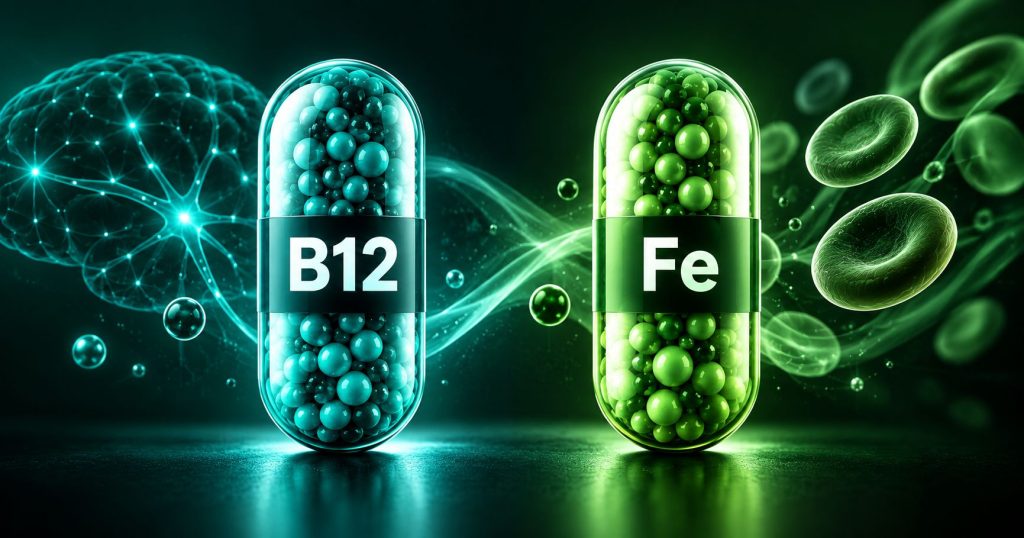
If you search “best supplements for energy,” most of what you’ll find is affiliate-driven listicles ranking products no one involved has ever taken, backed by vague claims about “boosting your metabolism.” This isn’t that.
What follows is a breakdown of the supplements most commonly marketed for energy — which ones have genuine evidence, which ones only work if you’re actually deficient, and which ones are mostly marketing. Every claim below is limited to what’s authorised under EU Regulation (EC) 1924/2006, not what supplement brands wish they could say.
The honest starting point: most healthy people who eat reasonably well don’t need an energy supplement. Persistent fatigue is usually a signal — of poor sleep, chronic stress, dehydration, or an underlying deficiency — not a gap that a pill fills. Supplements work best when they’re correcting an actual shortfall, not layering on top of an already adequate intake.
With that said — here’s what the evidence supports, and what it doesn’t.
The ones with strong evidence (when you’re actually low)
Iron
EFSA-authorised claim: Contributes to the reduction of tiredness and fatigue; contributes to normal oxygen transport in the body.
Iron is the single most evidence-backed “energy supplement” — but only if you’re deficient. It carries oxygen via haemoglobin; when levels drop, every cell in your body runs on less fuel. It’s the most common nutrient deficiency in the UK, particularly in women with heavy periods, vegetarians, and endurance athletes.
The catch: supplementing iron when you’re not deficient doesn’t boost energy — it can actually cause harm (nausea, constipation, and in rare cases iron overload). This is one supplement you should only take after a blood test confirms low ferritin.
What to look for: bisglycinate (“gentle iron”) forms cause less stomach upset than standard ferrous sulfate. Take with vitamin C to improve absorption; avoid taking with tea or coffee.
Our pick: Solgar Gentle Iron Bisglycinate
→ Full guide: Iron Deficiency Symptoms, Causes & Sources
Vitamin B12
EFSA-authorised claim: Contributes to the reduction of tiredness and fatigue; contributes to normal energy-yielding metabolism.
B12 is essential for red blood cell formation and neurological function. Deficiency causes a specific, measurable type of fatigue — not vague tiredness, but a deep, persistent exhaustion often paired with brain fog, poor concentration, and sometimes pins and needles.
If you eat meat, eggs, and dairy regularly, you’re probably getting enough. The people who genuinely benefit from B12 supplementation are vegans (almost universally), vegetarians, adults over 50, anyone on long-term metformin, and people with absorption issues.
What to look for: methylcobalamin (the active, methylated form) or cyanocobalamin (the stable, well-studied form). Sublingual tablets bypass some absorption issues.
Our pick: Solgar Methylcobalamin B12 1000mcg
→ Full guide: Vitamin B12 Deficiency Symptoms & Who’s at Risk
Magnesium
EFSA-authorised claim: Contributes to the reduction of tiredness and fatigue; contributes to normal energy-yielding metabolism.
Magnesium is one of the few nutrients with a specific, EFSA-authorised claim for reducing tiredness and fatigue — not just “contributing to energy metabolism” (which is a weaker, more generic claim). It’s involved in over 300 enzymatic reactions, including the conversion of food into ATP (cellular energy).
Sub-optimal magnesium intake is thought to be widespread in the UK/EU, driven by processed food, stress, alcohol, and certain medications. Unlike iron, magnesium supplementation is generally safe and well-tolerated, making it a reasonable first step even without a blood test (though one is always preferable).
What to look for: bisglycinate/glycinate for relaxation and sleep support; citrate for general use (slightly more laxative at higher doses). Avoid oxide — it’s cheap but poorly absorbed.
Our pick: Magnesium Bisglycinate 500mg
→ Full guide: Magnesium Deficiency: Signs, Causes & Sources
Vitamin D
EFSA-authorised claim: Contributes to normal muscle function; contributes to the normal function of the immune system.
Vitamin D doesn’t carry a direct “energy” or “tiredness” claim from EFSA — but low vitamin D is consistently associated with fatigue, muscle weakness, and low mood in observational studies, and the NHS recommends supplementation for everyone in the UK during autumn and winter. When people with low vitamin D supplement and feel more energetic, it’s likely because normal muscle function and immune function are being restored, not because D is an “energy booster” per se.
What to look for: D3 (cholecalciferol), ideally with K2 for calcium-directing benefits. 1000–2000 IU daily is a common maintenance dose for adults with limited sun exposure.
Our pick: Terranova Vitamin D3 2000 IU + K2
→ Full guide: Vitamin D Deficiency Signs & Sources
The ones with plausible evidence (but weaker or more specific)
CoQ10
No EFSA-authorised health claim — CoQ10 is not classed as an essential nutrient and doesn’t have approved energy-related claims in the EU.
That said, it has a clear biological role: CoQ10 is central to mitochondrial ATP production, and levels decline naturally with age (from mid-30s) and more sharply with statin use. Some studies in older adults show improvements in exercise tolerance and self-reported energy, though results are inconsistent.
The honest take: if you’re under 35, healthy, and not on statins, CoQ10 is probably not going to be the thing that fixes your fatigue. If you’re over 40 or on long-term statins, the rationale is more reasonable — but manage expectations.
Our pick: Solgar Vegetarian CoQ-10 200mg
→ Full guide: CoQ10 Benefits for Energy: What the Science Says
Ashwagandha
No EFSA-authorised health claim — ashwagandha is classified as a traditional herbal product, not an approved health-claim ingredient under EC 1924/2006.
Ashwagandha (Withania somnifera) is an adaptogen — a category of herbs traditionally used for stress resilience. Several randomised controlled trials have shown modest reductions in self-reported stress and cortisol levels, and some participants report improved energy as a downstream effect of reduced stress. The evidence is promising but not yet strong enough for EFSA approval.
If your fatigue is primarily stress-driven (high cortisol, poor sleep from racing thoughts, feeling “wired but tired”), ashwagandha is a reasonable addition to explore — alongside addressing the stress itself.
Our pick: Solgar Ashwagandha Root Extract
What probably doesn’t work (despite the marketing)
“Energy blend” multivitamins
Most “energy formula” multivitamins contain B vitamins and vitamin C at doses that are perfectly fine but won’t do anything if you’re not deficient — which, if you eat a varied diet, you probably aren’t in those specific nutrients. The marketing implies taking them will give you noticeable energy; the science says they’ll correct a shortfall if one exists and do nothing perceptible if it doesn’t.
Caffeine supplements
Caffeine is a stimulant, not a nutrient — it masks fatigue rather than addressing it. If you need caffeine to function, that’s worth investigating (sleep quality, iron levels, thyroid) rather than optimising your caffeine delivery system.
Ginseng, guarana, taurine
These have thin evidence for sustained energy improvement in well-designed trials. Some have short-term stimulant effects (guarana is essentially caffeine from a different plant), but none address underlying causes of fatigue.
So where should you start?
The most effective “energy supplement” depends entirely on why you’re tired — and that varies dramatically from person to person:
- Fatigue + heavy periods or plant-based diet → iron (after a blood test)
- Fatigue + vegan/vegetarian or over 50 → B12
- Fatigue + muscle cramps + poor sleep → magnesium
- Fatigue + limited sun exposure + winter → vitamin D
- Fatigue + stress-driven → magnesium + ashwagandha
- Fatigue + age 40+ or on statins → CoQ10
Rather than picking from a list, our free AI analysis looks at your specific combination of factors and recommends accordingly.
FAQ
Can I take all of these together? Most of these can be combined safely — magnesium, D3, B12, and vitamin C have no meaningful interactions at standard doses. Iron should be taken separately from zinc and calcium (they compete for absorption). CoQ10 and ashwagandha have no known interactions with these nutrients. If you’re on medication, check with a pharmacist before combining multiple supplements.
How quickly will I notice a difference? It depends on what’s actually causing your fatigue and how depleted you are. Magnesium and B12 can show effects within 1–2 weeks; iron typically takes 4–8 weeks to meaningfully rebuild stores; vitamin D can take several weeks to months to show noticeable improvement in energy.
Is there a single “best” energy supplement? No — and anyone telling you there is hasn’t asked what’s causing your fatigue. The best supplement is the one that corrects your actual gap.
Are expensive supplements better? Not necessarily. What matters is the form (bisglycinate vs oxide for magnesium, methylcobalamin vs cyanocobalamin for B12), the dose, and whether a reputable manufacturer made it. A well-formulated £10 product can outperform a £40 one with the wrong form or dose.
Sources & Further Reading
- NHS — Self-help tips to fight tiredness
- NIH Office of Dietary Supplements — Iron, Vitamin B12, Magnesium
- EFSA — EU Register of authorised health claims
- Tardy AL et al. (2020) — Vitamins and Minerals for Energy, Fatigue and Cognition: A Narrative Review (Nutrients, 2020)
- Examine.com — Iron, Magnesium, CoQ10, Ashwagandha
This article is for general educational purposes only and is not medical advice. Persistent or severe fatigue should be discussed with a GP.
As an Amazon Associate, Nutralyze earns from qualifying purchases. Affiliate relationships do not influence which nutrients we recommend.